The History of the Great Blue Hole

The History of the Great Blue Hole: From Ice Age Cave to One of the World's Most Famous Dive Sites

The Great Blue Hole is one of the most photographed natural wonders in the world.

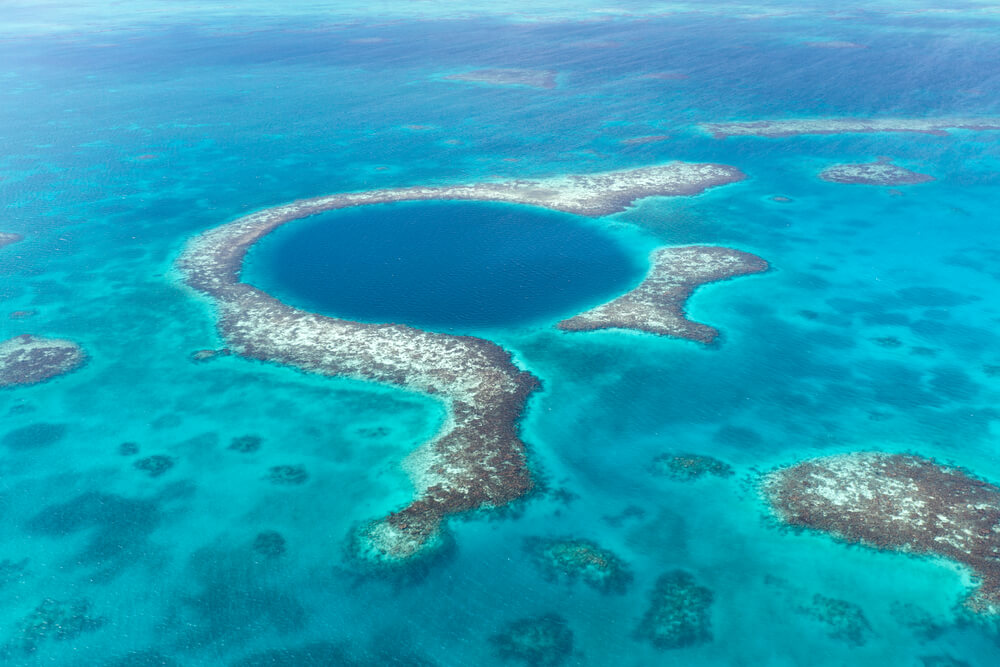
From the air, it appears as a nearly perfect dark blue circle surrounded by the turquoise waters of Lighthouse Reef Atoll. For divers, it is a bucket-list destination. For Belize, it has become an international symbol of the country’s marine environment.

But long before dive boats, GPS navigation, and underwater cameras, the Great Blue Hole was something very different.

Its story stretches back more than 150,000 years and includes Ice Age caves, Maya maritime routes, scientific expeditions, UNESCO protection, and some of the most important discoveries in modern diving.

This is the history of the Great Blue Hole.

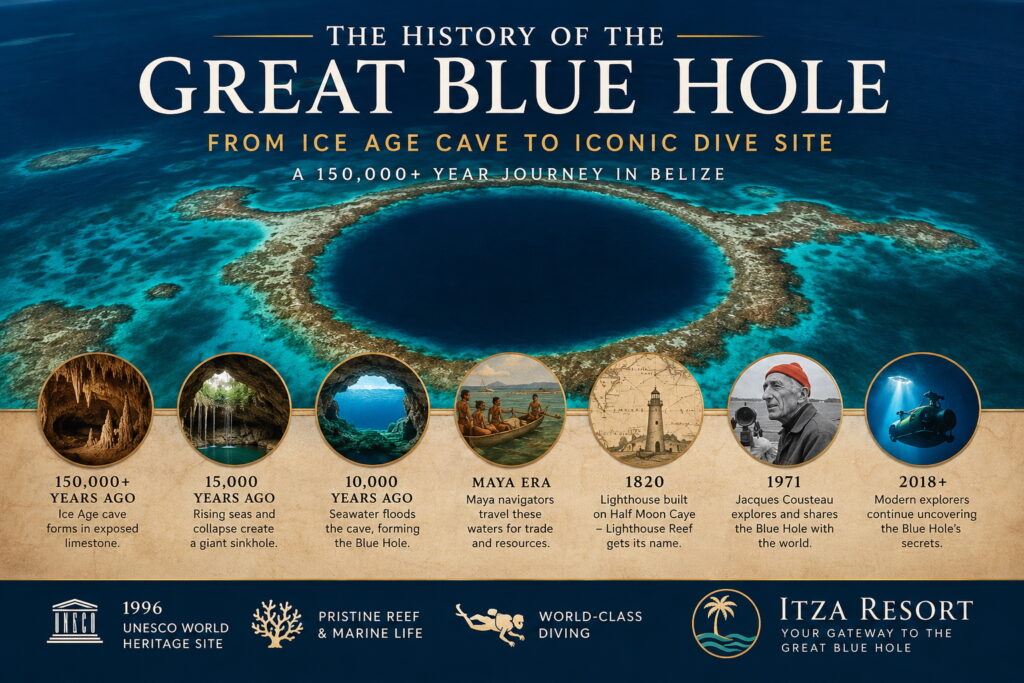
Great Blue Hole history timeline infographic showing the formation of Belize's famous marine sinkhole from Ice Age cave to UNESCO World Heritage Site
A visual timeline of the Great Blue Hole in Belize, tracing its journey from a 153,000-year-old Ice Age cave to one of the world's most famous dive sites and a UNESCO World Heritage attraction.

Before There Was a Blue Hole

Most visitors are surprised to learn that the Great Blue Hole was once a dry cave.

More than 150,000 years ago, during Ice Age conditions, sea levels were far lower than they are today. The area that now forms Lighthouse Reef Atoll was exposed limestone terrain.

Over thousands of years, rainwater slowly dissolved the limestone, creating a vast underground cave system.

As global climates changed and sea levels rose and fell through multiple Ice Age cycles, the cave expanded. Massive chambers formed beneath the surface, while stalactites and stalagmites grew inside the dry cave.

Evidence of these formations still exists today.

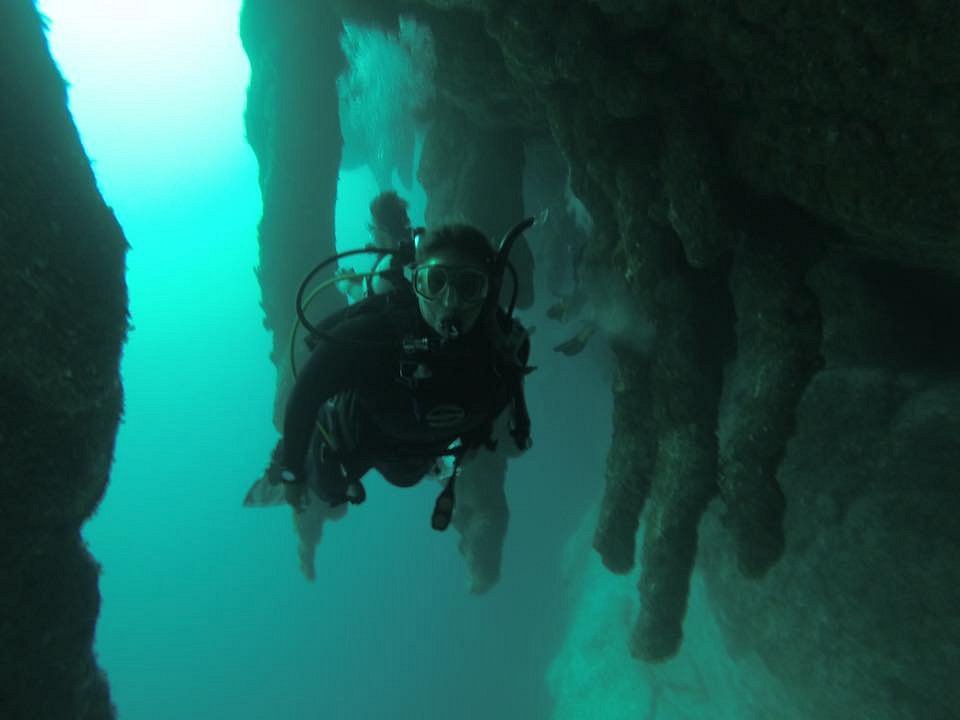
The giant stalactites divers see deep within the Blue Hole could only have formed in air, proving the cave once stood above sea level.

Rising Seas and the Birth of the Blue Hole

Around 15,000 years ago, the Ice Age began ending.

As glaciers melted around the world, sea levels started rising.

The roof of the cave eventually collapsed, creating a giant circular sinkhole. Over the following thousands of years, seawater flooded the cave system.

By approximately 10,000 years ago, the flooded sinkhole had become the marine feature we recognize today as the Great Blue Hole.

Coral reefs developed around the rim, eventually helping form the remarkable contrast between the deep blue center and the surrounding turquoise waters.

The Maya and Lighthouse Reef

Long before modern tourism arrived, Maya people were active throughout Belize and its coastal waters.

Archaeological discoveries on Long Caye within Lighthouse Reef Atoll show evidence of Maya presence in the area. Artifacts suggest that offshore islands and reefs played a role in maritime travel and trade networks.

While there is no evidence that the Maya visited the Blue Hole for diving or exploration, it is likely that experienced Maya navigators knew these waters well.

The Blue Hole was already part of the seascape long before it became famous.

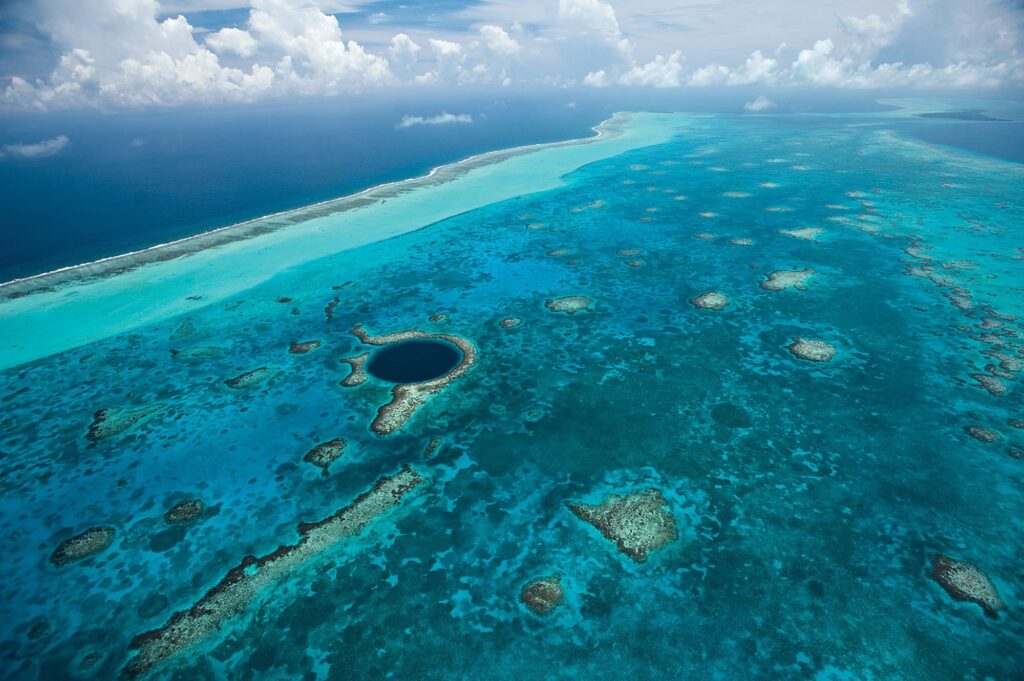
Aerial view of the Great Blue Hole at Lighthouse Reef Atoll in Belize showing deep blue sinkhole surrounded by coral reef and turquoise water
The Great Blue Hole at Lighthouse Reef Atoll — one of Belize’s most iconic and photographed dive sites, visible from both the air and underwater.

Lighthouse Reef Gets Its Name

In 1820, a lighthouse was established on Half Moon Caye.

The structure helped guide ships navigating the surrounding waters and eventually gave the atoll its modern name:

Lighthouse Reef.

Today, Lighthouse Reef Atoll remains one of the most remote and spectacular marine environments in Belize.

The Great Blue Hole sits near its center.

Before Jacques Cousteau

One of the biggest myths surrounding the Great Blue Hole is that Jacques Cousteau discovered it.

He did not.

Divers and underwater photographers were already documenting Belize’s reefs during the 1960s. The Blue Hole appeared in diving publications before Cousteau arrived.

What Cousteau did was far more important.

He showed the world why the Blue Hole mattered.

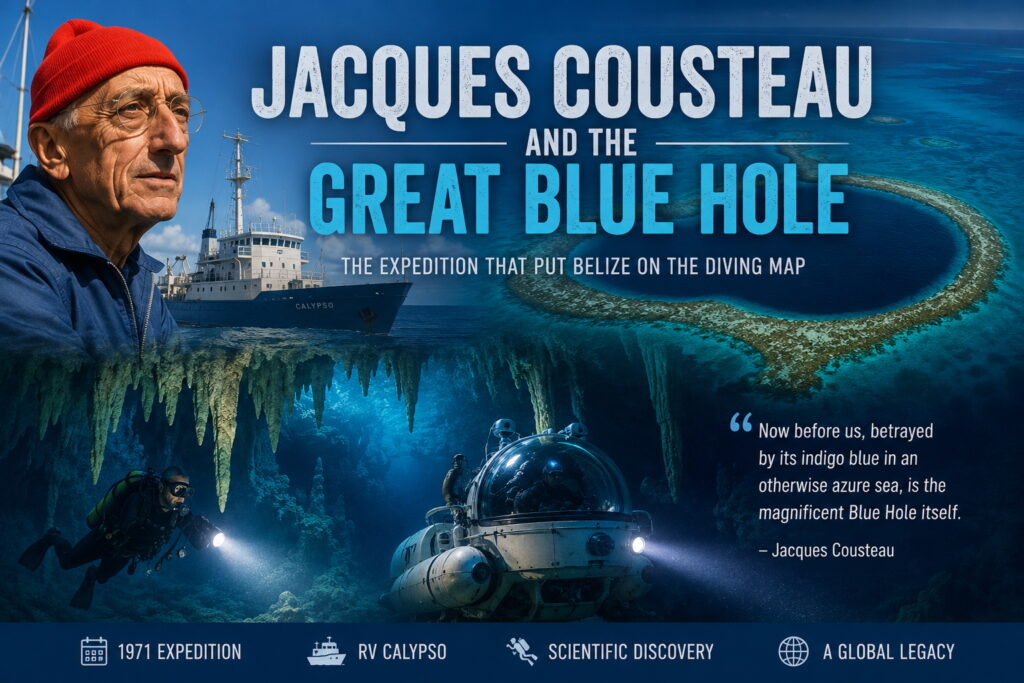
Illustration of Jacques Cousteau, the research vessel Calypso, and Belize's Great Blue Hole at Lighthouse Reef Atoll, highlighting the famous 1971 expedition that helped bring global attention to the Blue Hole.
Jacques Cousteau's 1971 expedition aboard the Calypso helped introduce Belize's Blue Hole and Lighthouse Reef Atoll to the world, inspiring generations of divers and marine explorers.

1971: The Expedition That Changed Everything

In 1971, legendary explorer Jacques-Yves Cousteau brought his research vessel, the Calypso, to Lighthouse Reef.

His team explored the Blue Hole, measured its depth, documented its underwater chambers, and retrieved stalactites from within the cave system.

The expedition confirmed that the Blue Hole had formed as a dry cave during periods of lower sea levels.

Cousteau’s television programs introduced the site to a global audience.

Suddenly, the Great Blue Hole was no longer just a geological curiosity hidden offshore Belize.

It had become one of the world’s most recognizable dive destinations.

blue hole, belize

A Long Caye Connection

During the Cousteau expedition, members of his team spent time on Long Caye while conducting research at Lighthouse Reef.

Today, Long Caye remains one of the most strategic locations for exploring the Great Blue Hole, Half Moon Caye, and the surrounding reef systems.

Unlike visitors making long day trips from the mainland, guests staying on Lighthouse Reef wake up within minutes of the dive sites.

The reef itself becomes part of the experience.

Protection and Conservation

As the global importance of Belize’s reef system became increasingly clear, conservation efforts expanded.

1981

Half Moon Caye became Belize’s first marine protected area and the first such reserve in Central America.

1996

The Belize Barrier Reef Reserve System was designated a UNESCO World Heritage Site.

The Great Blue Hole became part of an internationally recognized network of protected marine habitats.

This recognition helped strengthen efforts to preserve one of the world’s most remarkable reef systems for future generations.

The Great Blue Hole Gets Its Name

Another little-known fact is that Jacques Cousteau did not create the name “Great Blue Hole.”

The term is generally credited to British diver and author Ned Middleton in 1988.

Before that, many divers simply referred to it as the Blue Hole.

The addition of the word “Great” helped establish the landmark identity that continues today.

15 facts about the Great Blue Hole.

Scuba diver swimming between ancient underwater stalactites inside the Great Blue Hole at Lighthouse Reef Atoll, Belize
Diving inside Belize’s Great Blue Hole reveals massive limestone stalactites formed during the Ice Age when the cave system was above sea level.

Modern Discoveries

Even after decades of exploration, the Great Blue Hole continues to reveal new information.

In 2018, an expedition led by Fabien Cousteau, Richard Branson, Erika Bergman, and Aquatica Submarines returned to the site with advanced technology.

Their work produced the first complete 3D map of the Blue Hole.

The expedition documented:

  • Massive stalactites deep inside the cave
  • A hydrogen sulfide layer where oxygen disappears
  • Previously unseen geological formations
  • Plastic debris at depth
  • New insights into the sinkhole’s structure

Nearly fifty years after Jacques Cousteau’s original expedition, scientists were still making discoveries.

Richard Branson & Fabien Cousteau

Why the Great Blue Hole Matters Today

The Great Blue Hole is often described as a dive site.

In reality, it is much more than that.

It is:

  • A geological time capsule
  • An Ice Age cave system
  • Part of a UNESCO World Heritage Site
  • A symbol of Belize’s marine conservation efforts
  • One of the most famous underwater landmarks on Earth

Every dive into the Blue Hole is also a journey through time.

The stalactites were forming long before human civilization reached Belize.

The cave existed before the Maya.

Before European ships.

Before modern diving.

Before anyone imagined tourism at Lighthouse Reef Atoll.

Many come to study the Blue Hole or the Marine Life on the Atoll.

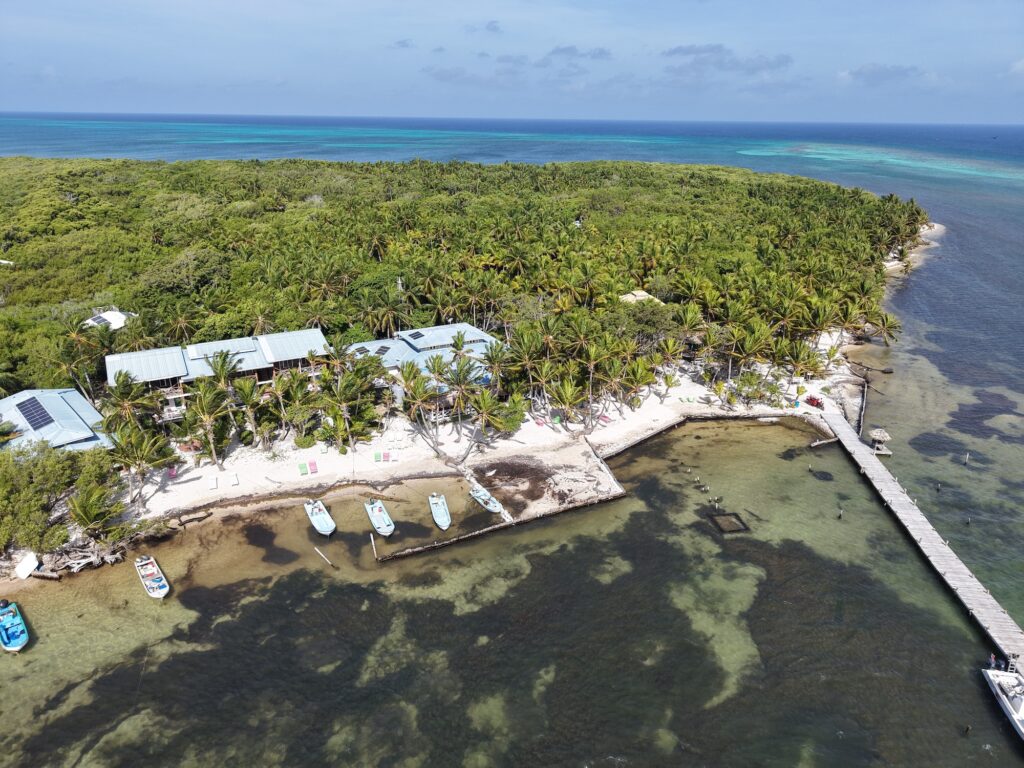
Itza Resort Belize aerial view on Lighthouse Reef Atoll in 2025
Aerial view of Itza Resort Belize in 2025 on Lighthouse Reef Atoll, near the Great Blue Hole.

Experience the Great Blue Hole from Lighthouse Reef

Most visitors experience the Great Blue Hole as a day trip involving several hours of boat travel.

Staying on Lighthouse Reef offers a different experience.

From Itza Resort on Long Caye, the Great Blue Hole is approximately 15 minutes away by boat. Half Moon Caye, the Lighthouse Reef walls, and some of Belize’s most spectacular coral formations are all nearby.

Instead of spending much of the day in transit, guests spend more time where the story actually happened — on Lighthouse Reef Atoll itself.

When you dive the Great Blue Hole from Long Caye, you are not just visiting a famous destination.

You are exploring one of the oldest and most remarkable natural stories in Belize.

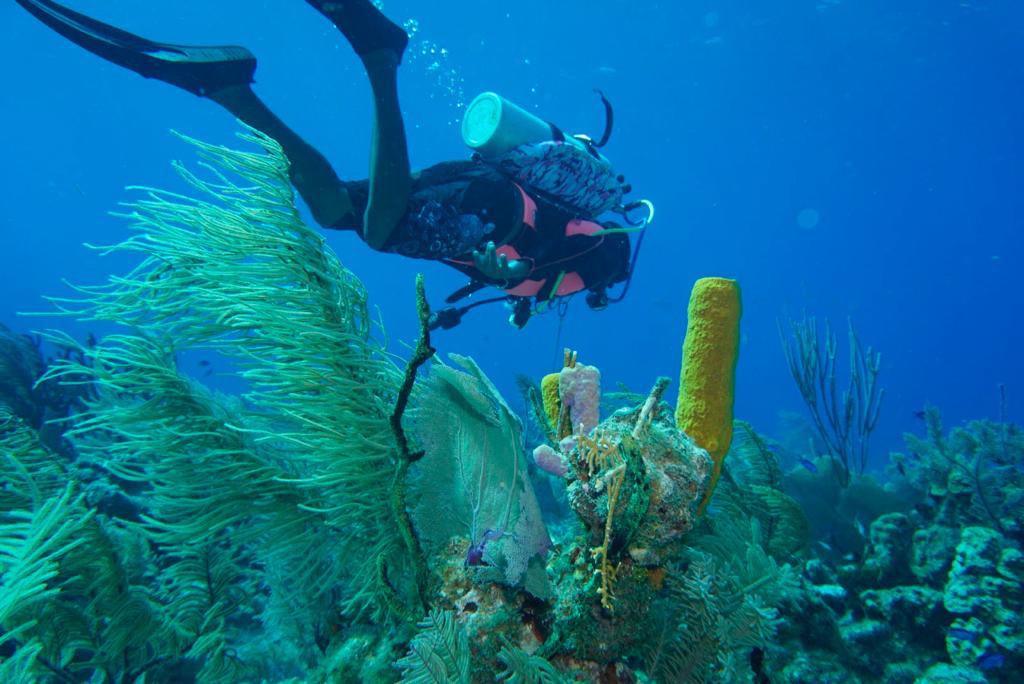
View from behind Elvis Solis scuba diving over a healthy Belize reef with orange sponges, sea fans, coral formations, and small tropical fish at Lighthouse Reef Atoll.

Who This Is For / Not For

✔ Certified divers
✔ Couples and small groups
✔ Reef-focused travelers
✔ Guests who enjoy quiet, remote places

May not be ideal for

✖ Luxury seekers
✖ Non-divers
✖ Nightlife travelers

Non-divers are welcome, especially if they enjoy snorkeling, quiet island time, and nature — but Itza Resort is built around reef access and diving.

Quick Reality Check

Before You Book
  • No A/C (naturally ventilated oceanfront rooms with sea breeze and fans)
  • Remote island (2h boat)
  • Built around diving
👉 Worth it if you understand it.

Why Itza Is Different

Why Divers Choose Itza

  • Dive sites 5–15 minutes away
  • Small group diving
  • More dives per day
  • Close access to the Great Blue Hole
  • Located on Lighthouse Reef Atoll

Next Step

Plan Your Dive Trip

→ Dive Packages
→ Blue Hole vs Ambergris
→ Real Cost of a Dive Trip
→ What It’s Like Staying Here

Ready to Plan Your Stay?

Trips to Lighthouse Reef take a bit more planning — from boat transfers to dive days.

If you’re considering it, we can help you put it together properly.

Check Availability or Get a Package Quote

1